
Laboratory Tweezers: Stainless, Ceramic & Soft Tips
Laboratory Tweezers: Stainless, Ceramic & Soft Tips
Laboratory tweezers may handle items as different as microscope coverslips, electronic components, thin films, coated samples, membranes, small fasteners, hot parts and optical hardware. A tool that performs well with a rigid metal component may crack glass, mark a coating, contaminate a specimen or generate particles when used for another task.
For professional laboratories and distributors, material selection should begin with the workpiece and the process—not with a broad product label. “Stainless steel,” “ceramic,” “ESD safe” and “non-marring” are useful categories, but none of them defines tip geometry, contact pressure, chemical compatibility, temperature limits, cleanliness or validated performance.
This guide compares stainless-steel, ceramic and replaceable non-marring laboratory tweezers. It also explains when titanium may be useful and provides a procurement framework for research facilities, electronics laboratories, optical laboratories, cleanrooms, OEM brands and technical distributors.
Important: Select tools according to the laboratory’s risk assessment, chemical-hygiene plan, contamination controls and equipment procedures. ESD-compatible tools are not automatically electrically insulated. Heat-resistant tools are not automatically safe for every heated process. This article is a procurement guide, not a substitute for laboratory training or a validated method.
Start With the Laboratory Task
The same tweezer should not automatically move between electronics, biological samples, optical components and chemical handling. Define the application before choosing a material.
| Laboratory task | Typical workpiece | Important tool characteristics | Primary risk |
|---|---|---|---|
| General sample handling | Foils, filters, slides, coverslips and small containers | Controlled tension, smooth edges and geometry matched to the sample | Crushing, scratching or cross-contamination |
| Electronics and sensor work | SMD parts, boards, sensors and connectors | Verified ESD behavior, alignment and fine access | Electrostatic discharge and mechanical damage |
| Optical and photonics work | Lenses, coated components, ferrules and housings | Non-marring contact, low particles and low closing force | Surface marks, contamination and coating damage |
| High-temperature bench work | Small heated parts or samples | Defined service temperature and thermal-shock resistance | Tool degradation, burns and sudden tip failure |
| Chemical laboratory work | Samples exposed to solvents, acids, bases or reagents | Documented compatibility with the exact chemical and conditions | Corrosion, swelling, embrittlement and contamination |
| Cleanroom or controlled environment | Wafers, precision assemblies and contamination-sensitive samples | Low shedding, validated cleaning and controlled packaging | Particle or molecular contamination |
| Cryogenic research | Small components used near low-temperature systems | Material and joint performance across the specified temperature range | Brittleness, thermal contraction and loss of alignment |
A laboratory using hazardous chemicals should manage tool selection and cleaning within its written chemical-hygiene program. In the United States, the laboratory standard in 29 CFR 1910.1450 requires covered employers to develop and implement a Chemical Hygiene Plan addressing procedures, equipment and work practices that protect personnel from laboratory chemical hazards.
Stainless-Steel Laboratory Tweezers
Stainless steel remains the most versatile material for general laboratory tweezers. It can be formed into fine points, broad paddles, curved jaws and serrated gripping surfaces. A suitable grade and heat-treatment condition can provide useful rigidity, spring action and wear resistance.
Advantages
- Fine and repeatable tip geometry
- Good rigidity for small hard parts
- Durable spring action when correctly manufactured
- Wide selection of straight, curved, blunt and specialty patterns
- Compatible with many established cleaning processes
- Can be polished, satin finished, matte finished or passivated as specified
Limitations
- Hard tips can scratch glass, polymers, coatings and soft metals
- Steel is electrically conductive
- Magnetic response varies by alloy and manufacturing process
- Corrosion resistance depends on grade, finish, passivation, chemical exposure and cleaning
- Fine points can bend or develop burrs after misuse or impact
“Laboratory-grade stainless steel” is not a measurable material specification. Buyers should identify the alloy or permitted alloy family, required condition, hardness where relevant, magnetic-property requirement, surface finish and corrosion test. A grade selected for flexible spring arms may differ from one selected for maximum tip hardness.
When Stainless Steel Is a Strong Choice
Stainless steel is generally suitable for small rigid components, fasteners, metal foils, robust specimens and general bench handling where direct metal contact is acceptable. Smooth broad tips can also handle delicate items when the force and contact area have been validated.
Avoid aggressive serrations when particle retention or surface marking is a concern. Serrations can improve grip on hard parts, but they also create recesses that are harder to inspect and clean.
Ceramic-Tip Laboratory Tweezers
Ceramic-tip tweezers combine a metal or polymer handle with ceramic contact tips. Depending on the ceramic grade and complete assembly, they may provide heat resistance, electrical insulation, low magnetic response and resistance to selected chemicals.
Advantages
- Useful temperature capability for selected heated bench tasks
- Electrical insulation properties, subject to material and construction verification
- Low magnetic response
- Hard, wear-resistant contact surfaces
- Resistance to many chemicals when compatibility is confirmed
Limitations
- Brittle tips may chip, crack or fracture after impact or side loading
- A damaged tip can become sharp or release particles
- Hard ceramic may scratch softer samples and coated surfaces
- The tip-to-handle joint may limit temperature or chemical performance
- White ceramic can make clear fibers or pale particles difficult to see
Ceramic should not be described as automatically non-scratch or universally chemically resistant. The ceramic composition, finish, edge geometry, joint design, contacted material and process conditions all affect suitability.
Fixed or Replaceable Ceramic Tips?
Fixed tips reduce the number of mechanical joints and can provide consistent alignment when properly assembled. Replaceable tips allow a laboratory to renew a damaged working end without discarding the complete tool. However, replaceable designs introduce screws, seats and interfaces that require inspection and cleaning.
For replaceable tips, define the replacement part number, screw material, tightening method, permitted torque, alignment after replacement and maximum number of service cycles. The supplier should also state whether replacement can be performed by the user or requires factory adjustment.
Non-Marring Polymer-Tip Tweezers
Non-marring tweezers use polymer or fiber-reinforced contact tips to reduce direct metal-to-sample contact. The tips may be permanently attached or replaceable. Common applications include optical housings, coated components, soft metals, polymer parts, delicate electronic packages and samples that can be marked by harder tools.
Advantages
- Lower hardness than most metal and ceramic tips
- Rounded profiles can distribute closing force
- Replaceable tips can extend the service life of the handle
- Compounds may be formulated for insulating, conductive or static-dissipative behavior
- Broad tips can grip larger components without sharp point contact
Limitations
- Tips may wear, creep, swell, soften or deform
- Some polymers retain contamination or absorb chemicals
- Fiber-reinforced tips can become abrasive when reinforcement is exposed
- Temperature capability is generally lower than ceramic or metal
- Black color does not prove ESD performance
“Non-marring” is a conditional performance description, not an absolute property. Even a soft tip can scratch a sample if it traps abrasive particles or if the operator applies excessive force. Validate the complete tool on representative surfaces using defined force, cleanliness and cycle conditions.
What About Titanium Tweezers?
Titanium is a useful fourth option for laboratories that prioritize low mass, corrosion resistance and low magnetic response. It can reduce hand fatigue during repeated precision work and is often considered for watchmaking, optical, research and electronics applications.
Titanium remains a hard, conductive contact material. It may still scratch delicate surfaces, and its chemical or temperature suitability must be verified. Solid titanium should not be confused with titanium-colored coatings or plated finishes.
Material Comparison
| Option | Rigidity | Marking risk | Electrical behavior | Main strength | Main limitation |
|---|---|---|---|---|---|
| Stainless steel | High, geometry dependent | Moderate to high on soft surfaces | Conductive | Fine geometry and durability | Can scratch; grade-specific corrosion and magnetism |
| Ceramic | High but brittle | Moderate to high on soft surfaces | Often insulating; verify assembly | Heat, wear and low magnetic response | Chipping and impact sensitivity |
| Engineering polymer | Low to moderate | Generally lower when clean | Compound specific | Broad, non-metal contact | Wear, deformation and chemical limits |
| Fiber-reinforced polymer | Moderate | Low to moderate | Compound specific | Improved stiffness with replaceable tips | Exposed reinforcement may become abrasive |
| Titanium | Moderate to high | Moderate | Conductive | Low mass and low magnetic response | Cost and hard-surface contact |
These are general tendencies. The supplier should provide product-specific data, and the buyer should validate the tool under the actual laboratory conditions.
Tip Geometry and Contact Pressure
Material alone does not determine sample safety. A fine polymer point can concentrate more pressure than a broad polished-steel paddle. Specify geometry and material together.
| Tip geometry | Typical application | Selection caution |
|---|---|---|
| Fine straight | Small rigid parts and direct-access placement | High local pressure; point damage reduces alignment |
| Fine curved or bent | Work around a low obstruction or under magnification | Side loads can bend steel or chip ceramic |
| Rounded blunt | Filters, flexible samples and broader components | May not access recessed or very small parts |
| Flat paddle | Films, membranes, foils and contact-area control | Parallelism and edge finish are critical |
| Reverse action | Holding a lightweight part during bench observation | Holding force and release direction must be understood |
| Long reach | Access inside fixtures or equipment after safe isolation | Lower tactile feedback and more arm flex |
Closing Force, Alignment and Surface Texture
Closing Force
Excessive spring tension increases hand fatigue and sample pressure. Very low tension can reduce control. Define the force required to close the tips at a stated arm opening and measurement location. Test the complete assembled tool, especially when tips are replaceable.
Alignment
“Perfect alignment” is not a measurable specification. Define the maximum lateral offset, crossing, twist and closed-tip gap. State the viewing direction, magnification and applied force. For broad tips, specify the required contact area rather than judging only the point.
Surface Texture
Smooth tips are generally easier to clean and less likely to imprint a sample. Serrated or textured tips may improve grip on hard components but can retain debris and increase marking risk. Specify texture coverage, direction, depth or roughness when it affects performance.
ESD-Controlled Laboratory Work
Laboratories handling electronic devices may need conductive or static-dissipative tweezers as part of an ESD-control program. The EOS/ESD Association’s ANSI/ESD S20.20 framework addresses elements including grounding, personnel grounding, protected areas, packaging, training, product qualification and compliance verification. Read the ESD Association’s overview of ANSI/ESD S20.20.
A tweezer should not be called ESD safe only because it is steel, black or carbon-fiber reinforced. Require the resistance range, test method, conditioning environment and test voltage where applicable. Evaluate the complete tool, including grips, coatings, joints and replaceable tips.
ESD compatibility is not electrical insulation. Conductive and static-dissipative tools may create an electrical-contact path and should not be used on energized equipment unless the exact procedure and tool are authorized for that task.
Chemical Compatibility
Statements such as “acid resistant” or “solvent resistant” are incomplete without the exact chemical and exposure conditions. Compatibility can change with:
- Chemical identity and concentration
- Temperature
- Exposure time
- Repeated cleaning cycles
- Mechanical stress during exposure
- Surface finish, coating and tip-to-handle joint
The body and tip may have different limits. A ceramic tip may tolerate a reagent that attacks its adhesive, screw or metal handle. A polymer may resist brief wiping but swell during immersion. Require compatibility data for the entire assembled tool and follow the laboratory’s safety data sheets and chemical-hygiene procedures.
Sterilization and Reprocessing
Do not describe laboratory tweezers as autoclavable, sterilizable or reusable through unlimited cycles without evidence for the complete design. Steam, dry heat, chemical sterilants and low-temperature systems place different demands on materials, joints and markings.
A reprocessing specification should define:
- Cleaning before sterilization
- Permitted detergent and water quality
- Sterilization method, temperature and exposure
- Maximum validated or tested cycles
- Drying and storage
- Post-process checks for corrosion, cracks, tip alignment and function
- Replacement criteria for polymer or ceramic tips
Laboratory suitability is not the same as medical-device compliance. If the product has a medical intended purpose, separate regulatory, biological-evaluation, labeling and reprocessing requirements may apply.
Cleanroom and Contamination-Control Claims
A material does not become cleanroom suitable merely because it looks smooth. The complete tool, cleaning process, packaging, particle generation and use conditions must be evaluated for the target environment.
For controlled environments, buyers may need to specify:
- Permitted materials, coatings and lubricants
- Particle-shedding or residue requirements
- Final cleaning and packaging process
- Double-bagging or controlled-area transfer method
- Lot traceability and inspection records
- Approved cleaning agents and frequency
- Dedicated storage and tool-identification method
ISO 14644 addresses cleanrooms and associated controlled environments, but citing the standard name alone does not prove that a tweezer is suitable for every cleanroom class or process. The buyer should define the specific contamination-control evidence required.
Recommended Laboratory Tweezer Set
A balanced distributor evaluation set may include:
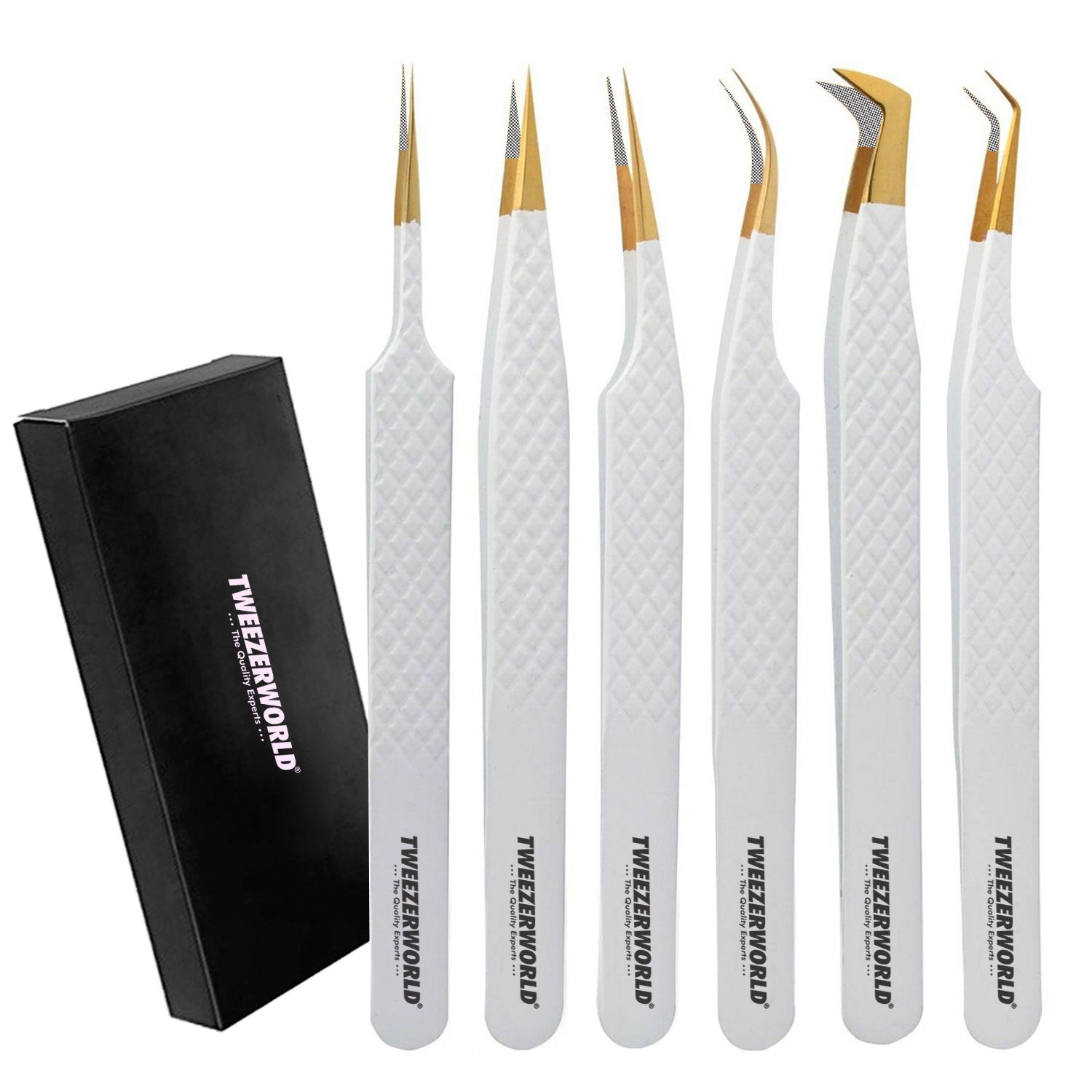
- Fine straight stainless-steel tweezer for small rigid parts.
- Fine curved stainless-steel or titanium tweezer for angled access under magnification.
- Rounded blunt stainless-steel tweezer for general low-risk handling.
- White ceramic-tip tweezer for selected heat-resistant or electrically isolated bench tasks.
- Rounded replaceable polymer-tip tweezer for coated, polymer or cosmetic surfaces.
- Flat paddle non-marring tweezer for films, membranes and broader samples.
- Reverse-action tweezer for controlled holding during inspection.
The final set should be built around the buyer’s procedures. Remove tools with no defined application, and keep chemically incompatible or contamination-sensitive tools in separate labeled storage.
OEM and Distributor Procurement Specification
| Procurement field | Recommended requirement |
|---|---|
| Intended use | Exact sample, component, contact area and laboratory environment |
| Model | Unique code linked to drawing, label and inspection report |
| Body material | Exact stainless-steel, titanium or permitted material specification |
| Tip material | Exact alloy, ceramic grade or polymer compound |
| Overall dimensions | Length, width, thickness and tolerances |
| Tip geometry | Width, thickness, angle, radius and contact length at defined points |
| Alignment | Maximum gap, offset, crossing and twist under a defined force |
| Closing force | Acceptable range at a stated opening and measurement location |
| Surface finish | No burrs, pits, sharp unintended edges, residue, cracks or loose coating |
| ESD requirement | Electrical-resistance range, test method and conditions where applicable |
| Magnetic property | Defined test and acceptance limit if required |
| Chemical compatibility | Named substances, concentrations, temperature and exposure duration |
| Temperature | Maximum and minimum service conditions for the complete tool |
| Cleaning or sterilization | Defined process and supported cycle count |
| Replaceable tips | Part number, fitting method, tightening requirement and spare availability |
| Packaging | Individual tip protection and contamination-control level |
| Documentation | Drawing, material declaration, inspection report and relevant test evidence |
| Change control | No material, geometry, coating or process change without buyer approval |
Incoming Inspection and Validation
Approve each model against a controlled drawing and signed golden sample. The inspection plan can include:
- Overall and tip dimensions
- Tip alignment, contact pattern and closed gap
- Closing force and spring return
- Magnified inspection for chips, burrs, cracks, exposed fibers and contamination
- Replaceable-tip fit and fastener security
- Electrical-resistance testing where specified
- Chemical-cleaning or sterilization cycle trials
- Repeated handling tests on representative dummy or retired samples
After handling trials, inspect the workpiece as well as the tool. A tweezer can successfully pick up a sample while still leaving marks, particles or deformation that are not immediately visible.
Claims That Should Be Qualified
- Non-marring: identify the surface, closing force, cleanliness and number of test cycles.
- Non-magnetic: state the test method and limit rather than making an absolute claim.
- ESD safe: provide resistance data and test conditions for the complete tool.
- Chemical resistant: identify chemicals, concentrations, temperatures and exposure times.
- Autoclavable: state cycle parameters, number of cycles and post-test acceptance.
- Cleanroom compatible: identify the target environment and contamination-control evidence.
- High temperature: provide the supported service condition for the full assembly, not only the tip material.
Frequently Asked Questions
Which material is best for laboratory tweezers?
No material is best for every laboratory task. Stainless steel is versatile and rigid, ceramic can support selected heat or electrical-isolation tasks, and polymer tips can reduce marking on delicate surfaces. Selection depends on the workpiece and process.
Are ceramic tweezers safer for delicate samples?
Not automatically. Ceramic is hard and brittle. It can scratch a softer surface or chip after impact. Its suitability depends on tip finish, geometry, closing force and the sample material.
Are non-marring tweezers guaranteed not to scratch?
No. Contamination, worn tips and excessive force can make even a soft polymer tip damage a surface. Validate the tool on representative samples.
Can stainless-steel laboratory tweezers be autoclaved?
Some complete designs may tolerate defined steam cycles, but the claim must be supported for the exact alloy, finish, joints and markings. Specify cycle conditions and post-process inspection.
Are black polymer tweezers ESD safe?
Color does not determine resistance. Require the exact compound, resistance range, test method and conditions.
What should an OEM buyer request before ordering?
Request a controlled drawing, material identification, tip geometry, alignment and force criteria, cleaning or chemical-compatibility information, inspection records, packaging details and change-control terms.
Select the Tool by Contact Risk
Professional laboratory tweezers should be specified around the contacted sample, not a general material label. Stainless steel offers durability and fine geometry. Ceramic provides useful heat, wear and electrical characteristics for selected tasks. Non-marring polymer tips reduce hard metal contact but introduce their own wear, contamination and temperature limits.
TWEEZER WORLD® supports laboratory suppliers, electronics distributors, research facilities and OEM brands with custom tip geometry, stainless-steel and titanium options, fixed or replaceable ceramic tips, non-marring polymer tips, private-label marking, protective cases and agreed inspection criteria. Explore our ESD and anti-static tweezers and OEM and private-label manufacturing.
Request a Laboratory Tweezer Evaluation Set
For an accurate quotation, provide representative components, permitted contact areas, laboratory environment, preferred materials, ESD requirements, chemical or temperature conditions, cleaning method, branding, packaging, quantity and destination market.
Papular Products Gallery